publications
2025
-
 Exploring the Design Space of Adaptive Polymorphism Models through the Production–Regulation FrameworkYuksel O.*,Preprint, 2025
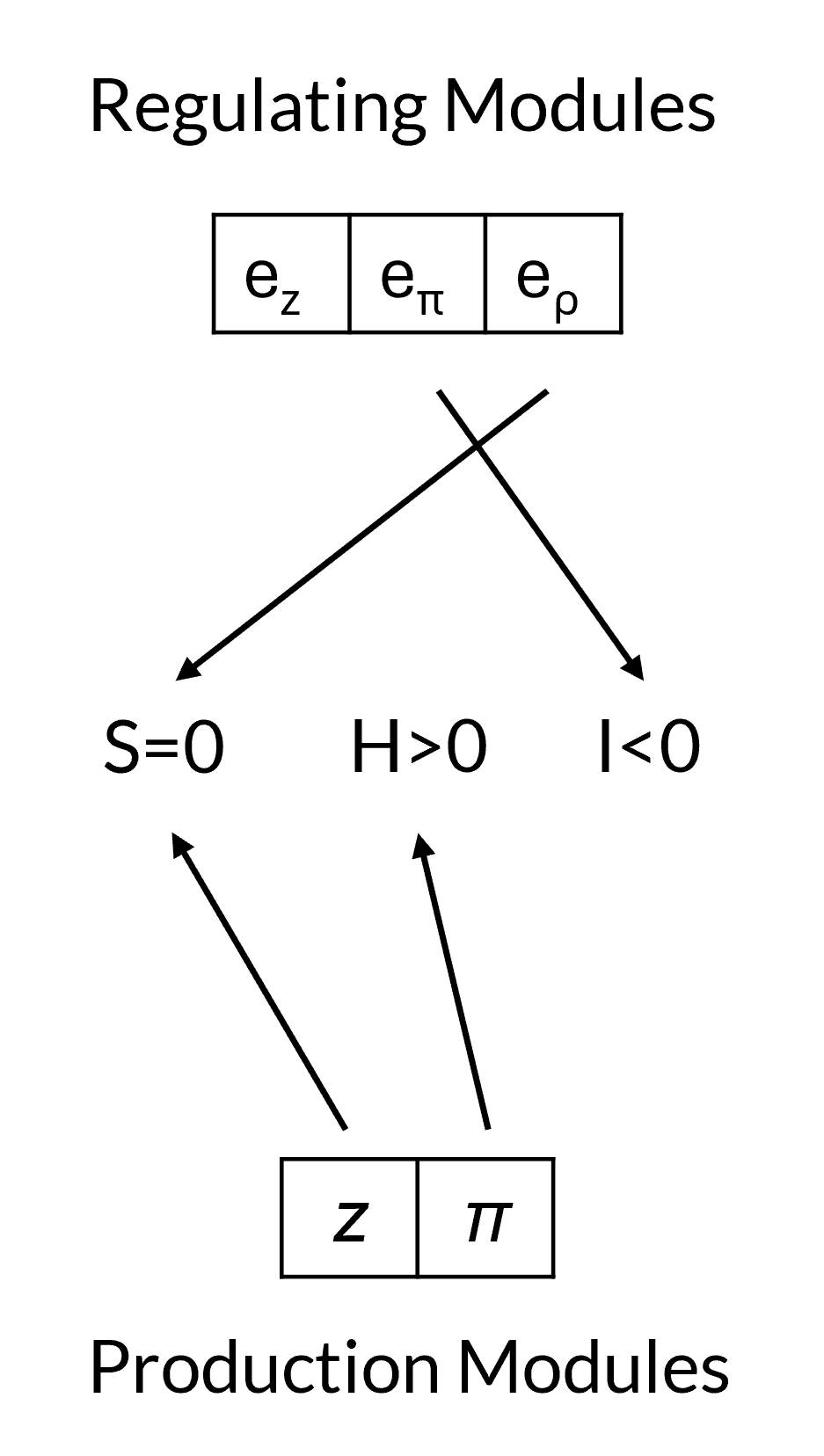
This note is a model-construction companion to [Lehmann & Mullon, 2025], which established the mathematical conditions for evolutionary branching and coexistence in oligomorphic populations. Here, those conditions are translated into a library of interchangeable biological modules, each representing a distinct causal mechanism grounded in the production–regulation decomposition. Modules are categorized by their primary functional contribution to the three necessary branching conditions: establishing a singular strategy (S=0), generating disruptive selection (H>0), and providing stabilizing feedback (I<0). By systematically combining these building blocks including coupled modules that influence multiple conditions, users can both classify existing models and generate new, testable hypotheses, covering the full design space from well-established cases to novel hybrid scenarios. Crucially, this framework embeds the S-H–I decomposition within the full stability pipeline of the parent theory, adding convergence stability, hyperbolic stability, and qualitative dissimilarity as essential final checks before a constructed scenario can be considered a plausible, stable adaptive polymorphism.
-
 Reciprocal Negative Feedbacks Stabilize an Emergent Polymorphism in aCross-Feeding Microbial ConsortiumYuksel O.*,Preprint, 2025
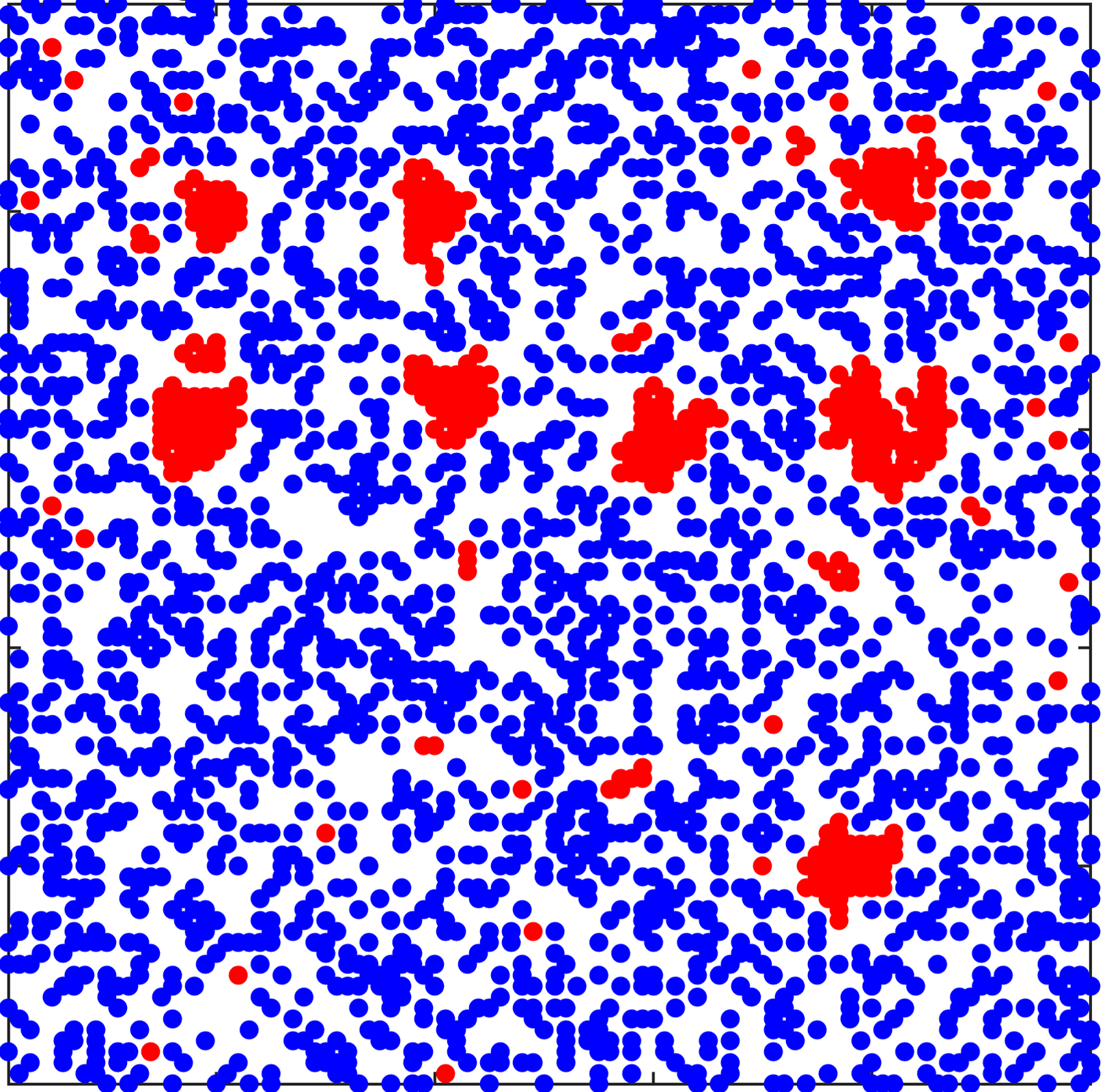
Pseudomonas putida presents a well-defined biological problem, as this diversity is conditional on a cross-feeding interaction with a partner species, Acinetobacter johnsonii (Al-Tameemi and Rodríguez-Verdugo, 2024). To formally dissect this problem, we apply the theoretical framework of Lehmann and Mullon, 2025 using a modular approach . This deconstructs any stable adaptive polymorphism into three necessary functional components: a trade-off (S-Condition), disruptive selection (H-Condition), and stabilizing feedback (I-Condition). Two of these components are well-explained by established mechanisms in this system. The S-Condition (the trade-off) is established by a Phenotype level Production module, where a single, large-effect mutation in the fleQ gene creates an intrinsic resource allocation trade-off between motility and metabolic uptake efficiency, giving rise to the high-yield harvester morph (Al-Tameemi and Rodríguez-Verdugo, 2024). The H-Condition (disruptive selection) is generated by a Phenotype level Regulation module. The partner species, A. johnsonii, acts as a niche constructor by creating a heterogeneous landscape of benzoate patches, which favors the distinct specialist strategies of the forager and harvester while selecting against intermediates (Christensen et al., 2002; Hansen et al., 2007). This deconstruction reveals that the I-Condition (stabilizing feedback) is the core of the unresolved puzzle. Reciprocal invasion assays in well-mixed liquid cultures failed to detect the negative frequencydependent selection required for coexistence, explicitly ruling out a simple, spatially-independent mechanism (AlTameemi and Rodríguez-Verdugo, 2024). The framework thus guides the formulation of three distinct, spatiallyexplicit hypotheses for this unknown stabilizing mechanism.


2024
-
 Game Theoretical Analysis of Cooperation and Cheating Among Lipase Producing Candida rugosa Sub-CulturesYuksel O.*, Nikerel E.Preprint, 2024
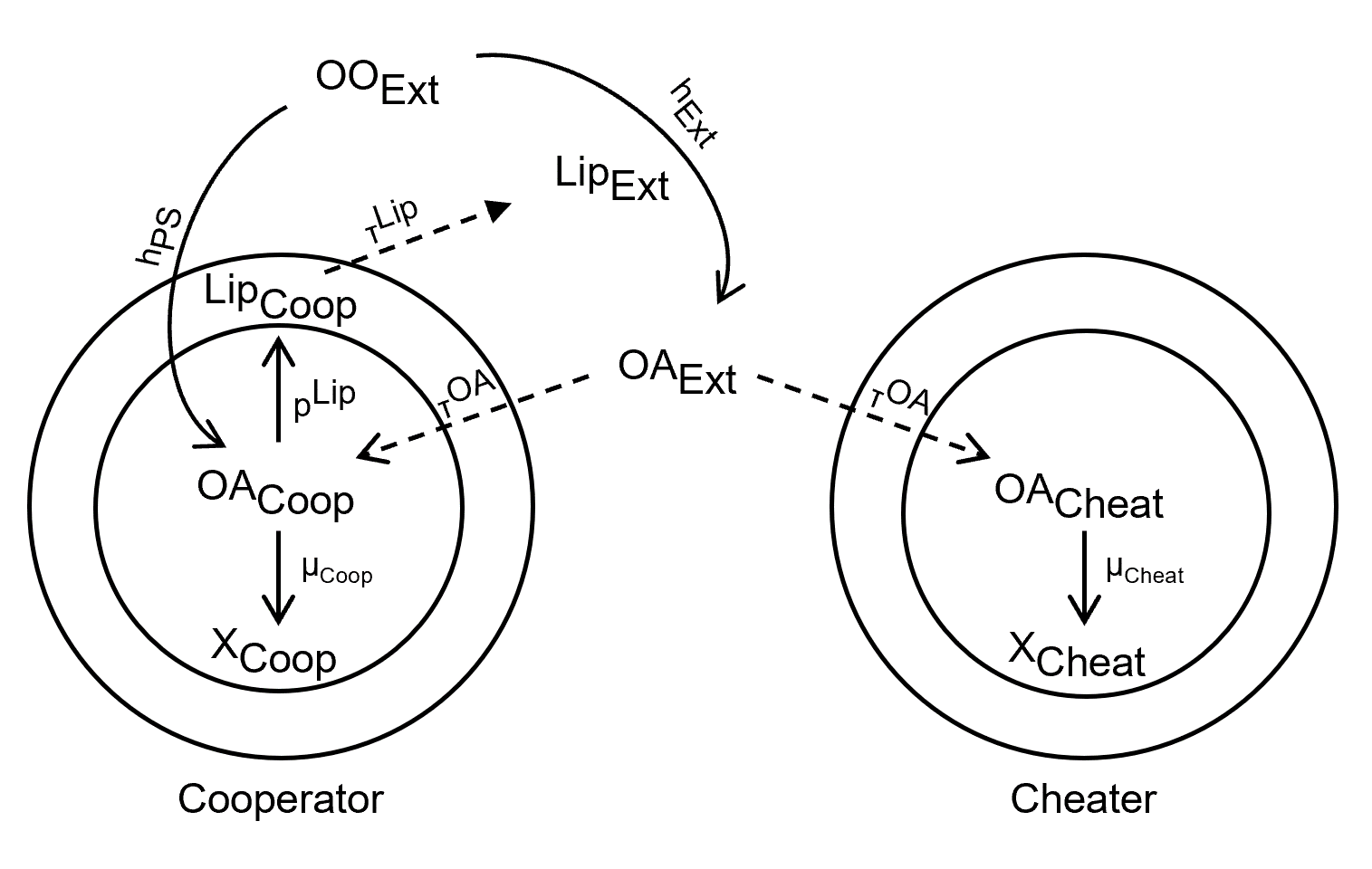
Game theory provides a mathematical framework for understanding social dilemmas and conflicts of interest among agents striving to maximize personal gain. In microbial populations, different phenotypes, such as complete or partial failure in exoenzyme production, can be seen as strategies in a game where cell growth rates indicate the fitness of each strategy. This research focuses on the interplay between wildtype "Cooperator" cells and "Cheater" cells that do not produce, with population productivity depending on the dynamics of exoenzyme production, transportation, and hydrolysis. We present a novel successive simulation methodology to analyze the long-term evolutionary dynamics of lipase-producing Candida rugosa that make use of structured mathematical models at the ecological scale. Key results show that fermentation dynamics are influenced by substrate availability and initial population densities. Batch fermentations favor Cooperators due to localized hydrolysis, while fed-batch conditions benefit Cheaters by increasing extracellular hydrolysis. The Stable State Finder algorithm highlights that high lipase production costs and suboptimal substrate concentrations can lead to Cheater dominance and reduced enzymatic output. For biotechnological applications, optimizing initial total density and substrate concentrations is essential to maximizing enzymatic activity while preserving cooperative stability. Overall, our study provides a comprehensive understanding of environmental currency in evolutionary games and offers a novel and robust framework for analyzing evolutionary stable states in microbial populations.
